
| Exercise Goal | Key Participants | Length | Incident Severity |
| Team members experience how an incident can evolve over multiple days and rehearse responses at each stage. | Cross-functional team (District Leadership, Tech, Dept. Leadership) | 2-3 hours | Low → Critical |
Resource Downloads
Google Slides | PowerPoint | PDF
Purpose
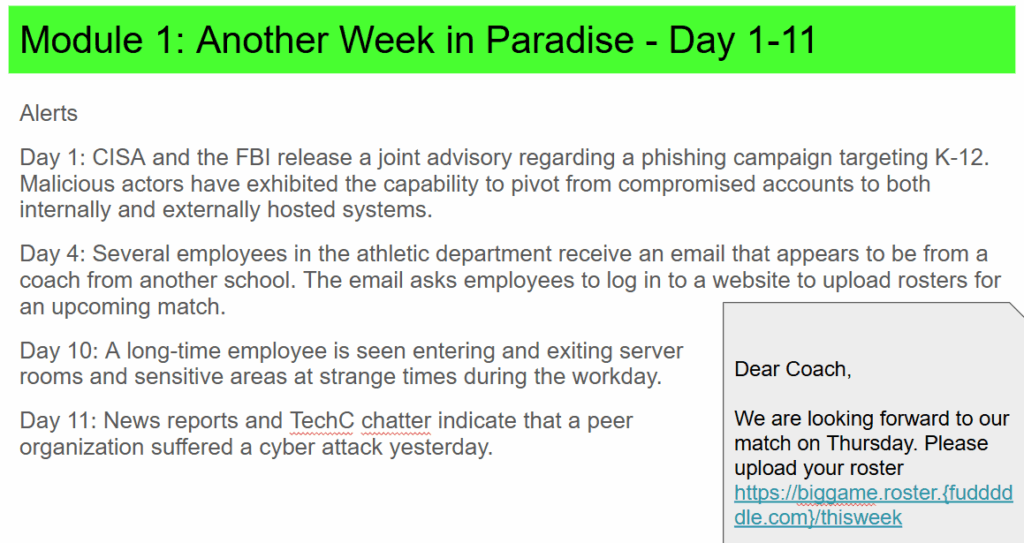
This exercise is a traditional larger scale scenario featuring multiple “injects” (new developments). Your team will navigate the response to each stage using your Cybersecurity Incident Response Plan (CSIRP) as a guide. The exercise focuses on evaluating the tools, tactics, training, and relationships necessary to mitigate risk and impact as an incident escalates.
Participant Profile
- Ideal Composition: A cross-functional team including District Leadership, the Tech Team, and Department Heads (e.g., HR, Finance, Operations).
- Flexible Roles: If key individuals are not present, their roles should be assigned to other participants to ensure all departmental perspectives are represented.
Prerequisites
There are no formal prerequisites. However, familiarity with the district’s current incident response procedures will allow for a more productive and realistic experience.
Prioritized Outcomes
- Plan Validation & Optimization: Identify gaps in current planning and technical documentation to refine and validate incident response plans and playbooks.
- Operational Readiness: Train personnel on plan execution and rehearse response procedures to build the “muscle memory” needed for a swift, instinctive reaction.
- Role & Skill Alignment: Clarify specific roles and responsibilities while identifying gaps in team coordination, knowledge or technical skills.
- Strategic Coordination & Awareness: Enhance communication across different departments and deepen the collective understanding of threat types, business impacts, and prevention.
Facilitator Notes
Role of the Facilitator: We strongly recommend a facilitator who is not a participant. The facilitator should provide context relevant to the organization and purposefully push the team out of their comfort zone.
Not a “Whodunit”: Remind participants that this is not a mystery to be solved. It is a series of events that may or may not be related. Participants should address each “inject” as it occurs, looking for connections without waiting for a single “aha!” moment or a simple solution. The focus is on the process of response, not just the “answer.”
© 2026 MAISA/MiSecure. This work is licensed under CC BY 4.0.